Healthy aging
Chiropractic Care and Fall Risk in Older Adults
Falls are the leading cause of injury for adults 65 and older. Here is what the numbers show about falls and recovery, and what research has found about chiropractic care and the things that keep you steady.
How common are falls after 65?
According to the CDC, over 14 million older adults, or 1 in 4, report falling every year. Each year falls among older adults lead to:
- About 4.5 million emergency department visits. 3.1 million are treated and released.
- 1.4 million hospitalizations.
- Nearly 319,000 hospital stays for hip fractures. Falls cause 88% of emergency visits and hospitalizations for hip fractures.
The CDC also describes older adult falls as common, costly and preventable.
Fall death rates rise sharply after 85
In 2023, 41,400 adults 65 and older died from unintentional falls in the United States, according to the National Center for Health Statistics. Falls are the leading cause of injury-related death in this age group, and the rate climbs with every decade:
- Ages 65 to 74: 19.2 deaths per 100,000.
- Ages 75 to 84: 74.7 deaths per 100,000.
- Ages 85 and older: 339.5 deaths per 100,000, or 373.3 for men and 319.7 for women.
Adults 85 and older accounted for 21,031 of those deaths, just over half. Florida recorded 4,045 fall deaths among adults 65 and older in 2023, a rate of 82.3 per 100,000, above the national rate of 69.9. Rates rose between 2003 and 2023 for men and women in every older age group, and the CDC reports the age-adjusted fall death rate for older adults rose 21% from 2018 to 2024.
What recovery looks like after a hip fracture
A 2019 systematic review in the World Journal of Orthopedics, covering 36 studies and nearly 230,000 patients, found a one-year mortality rate of about 22% after a hip fracture, and 21% in the United States. That number has improved from the 30% long quoted, as hospital care for hip fractures has gotten better.
For those who recover, a 2016 review of 38 studies in BMC Geriatrics found:
- 40% to 60% regained their pre-fracture mobility and their ability to handle tasks like shopping and housework.
- 40% to 70% regained their independence in basic daily activities like bathing and dressing.
- 20% to 60% of people who had been independent needed help with some tasks one and two years later.
- 10% to 20% moved into residential care after the fracture.
Most of the recovery in walking and daily activities happened within the first six months.
What research shows about chiropractic care and fall risk
Research on chiropractic care and balance in older adults is growing. Four studies stand out.
A 2016 randomized controlled trial in older adults. Researchers in Auckland, New Zealand enrolled 60 adults over 65. Half received 12 weeks of chiropractic care and half received no care. The chiropractic group got 119 milliseconds faster on a choice stepping reaction test, a measure linked to fall risk. They also improved in ankle position sense, your ability to feel where your foot is without looking, and in the physical side of quality of life.
A 2014 study of older Medicare patients. Researchers at the University of Iowa compared older adults who used chiropractic care for uncomplicated back conditions with those who used medical care, over two years. The chiropractic group had about half the odds of declining in basic daily activities like bathing and dressing, and lower odds of declining in tasks like shopping and housework and in self-rated health.
A 2018 study on the brain's balance center. The cerebellum sits at the back of the brain and coordinates movement. According to Cleveland Clinic, people with damage to the cerebellum usually have trouble keeping their balance while standing or walking. Researchers from Ontario Tech University, the New Zealand College of Chiropractic and Brock University studied 27 adults ages 18 to 27 with mild, recurring neck pain. Fourteen received a chiropractic adjustment to the neck and thirteen received a sham version. Twelve people without neck pain took part as a comparison group. After everyone learned a new finger movement, the researchers measured how strongly the cerebellum was holding back the motor cortex, the part of the brain that sends movement commands to your muscles:
- No neck pain: 98%. The cerebellum eased off as they learned, the normal healthy response.
- Neck pain, sham: 58%. The cerebellum stayed on the brake.
- Neck pain, adjusted: 146%. The brake released, and the connection shifted toward helping the new movement along.
That change came from a single adjustment, and the authors concluded it moved the interaction in the direction of the healthy response. The paper also cites earlier research in which older adults with neck pain performed significantly worse on sensorimotor tests than older adults without it.
A 2012 systematic review. Of 11 trials that tested manual therapy, including chiropractic care, 9 reported improvements in balance. The reviewers called for larger trials that track falls directly, which is where the research is headed next.
Movement matters too
A 2019 Cochrane review of 108 trials found that exercise reduces falls in older adults by about 23%, with balance and functional exercises showing the strongest evidence. Staying active, with a body that moves without pain, is part of the picture.
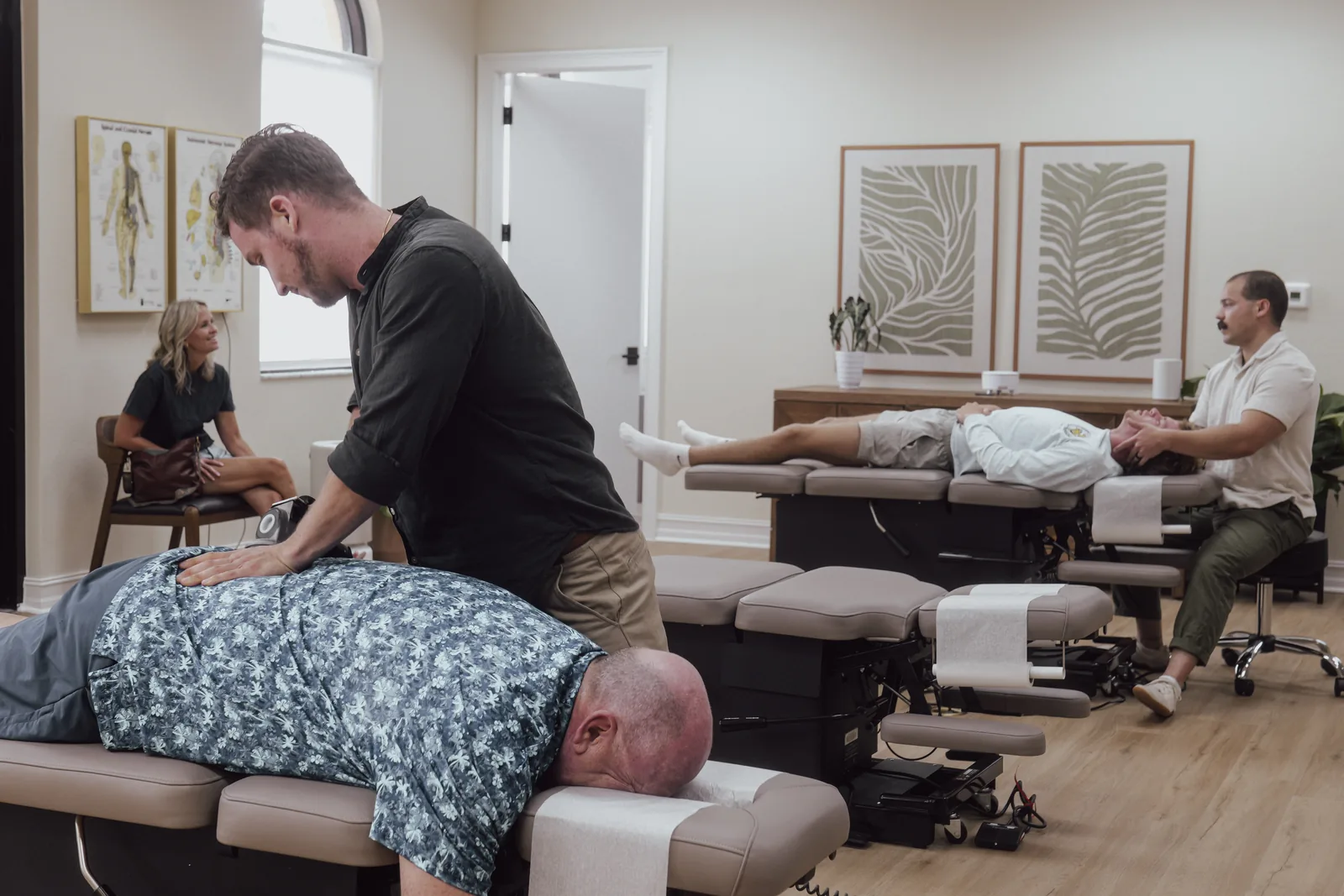
How Crown supports balance and mobility
At Crown, our doctors look at how the spine, nervous system and muscles are working together before building a plan. Dr. Diego Torres provides chiropractic adjustments, and Dr. Gabe Mash runs our modalities department, including PEMF therapy. Where it helps, functional medicine and nutrition round out the picture.
If your parents or grandparents are looking for ways to stay comfortable and moving well, an assessment at Crown is a good first step.

Sources
- Holt KR, Haavik H, Lee AC, Murphy B, Elley CR. Effectiveness of chiropractic care to improve sensorimotor function associated with falls risk in older people: a randomized controlled trial. Journal of Manipulative and Physiological Therapeutics, 2016.
- Weigel PA, Hockenberry J, Bentler SE, Wolinsky FD. The comparative effect of episodes of chiropractic and medical treatment on the health of older adults. Journal of Manipulative and Physiological Therapeutics, 2014.
- Baarbé JK, Yielder P, Haavik H, Holmes MWR, Murphy BA. Subclinical recurrent neck pain and its treatment impacts motor training-induced plasticity of the cerebellum and motor cortex. PLoS One, 2018.
- Holt KR, Haavik H, Elley CR. The effects of manual therapy on balance and falls: a systematic review. Journal of Manipulative and Physiological Therapeutics, 2012.
- Garnett MF, Weeks JD, Zehner AM. Unintentional fall deaths in adults age 65 and older: United States, 2023. NCHS Data Brief No. 532, 2025.
- Downey C, Kelly M, Quinlan JF. Changing trends in the mortality rate at 1-year post hip fracture: a systematic review. World Journal of Orthopedics, 2019.
- Dyer SM, Crotty M, Fairhall N, et al.. A critical review of the long-term disability outcomes following hip fracture. BMC Geriatrics, 2016.
- Centers for Disease Control and Prevention. Older Adult Falls Data. CDC.
- Centers for Disease Control and Prevention. Older Adult Falls Facts. CDC.
- Cochrane. New Cochrane Review assesses the benefits and harms of exercise for preventing falls in older people living in the community. 2019.
- Cleveland Clinic. Cerebellum: What It Is, Function and Anatomy. Cleveland Clinic.
Good to know
Questions patients ask
How common are falls in older adults?
Falls are the leading cause of injury for adults 65 and older. According to the CDC, over 14 million older adults, or 1 in 4, report falling every year.
How does fall risk change after age 85?
Fall death rates rise sharply with age. In 2023, the unintentional fall death rate for adults 85 and older was 339.5 per 100,000, compared with 19.2 per 100,000 for adults 65 to 74, according to the National Center for Health Statistics.
Is there research on chiropractic care and fall risk in older adults?
Yes. In a 2016 randomized controlled trial of 60 adults over 65, the group that received 12 weeks of chiropractic care got 119 milliseconds faster on a stepping reaction test linked to fall risk, compared with a group that received no care.
Can a chiropractic adjustment affect the brain?
A 2018 study in PLoS One found that one chiropractic adjustment to the neck improved how the cerebellum and the motor cortex worked together in people with recurring neck pain, shifting that connection toward the pattern seen in people without neck pain.
Wear your crown
Ready to keep moving well?
Book online in a couple of minutes, or call and our team will help you find a time. New patients welcome.